NASA’s Webb Captures Commotion From Nebula’s Stellar Jets
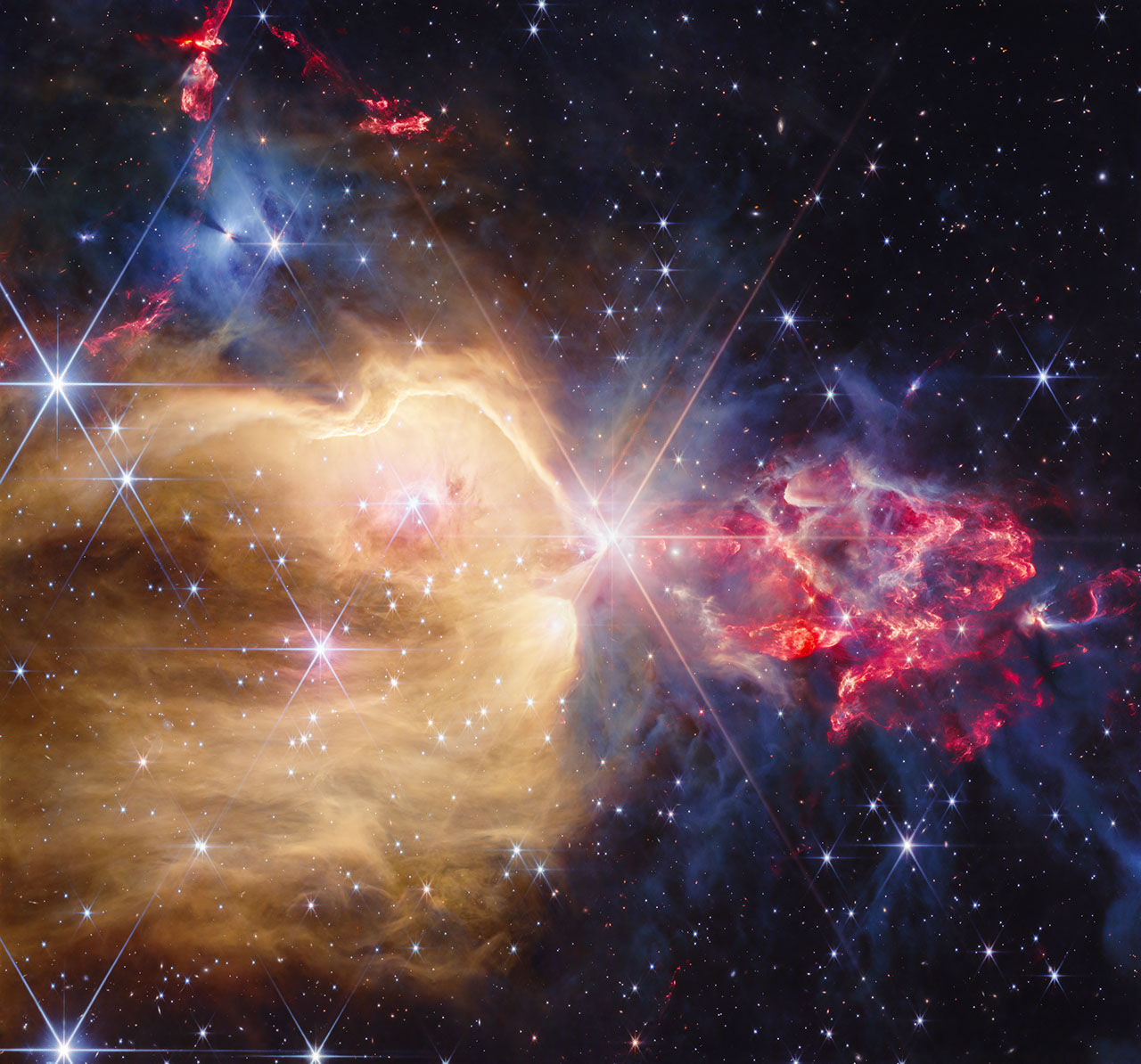
Image: NASA, ESA, CSA, STScI; Image Processing: Alyssa Pagan (STScI)
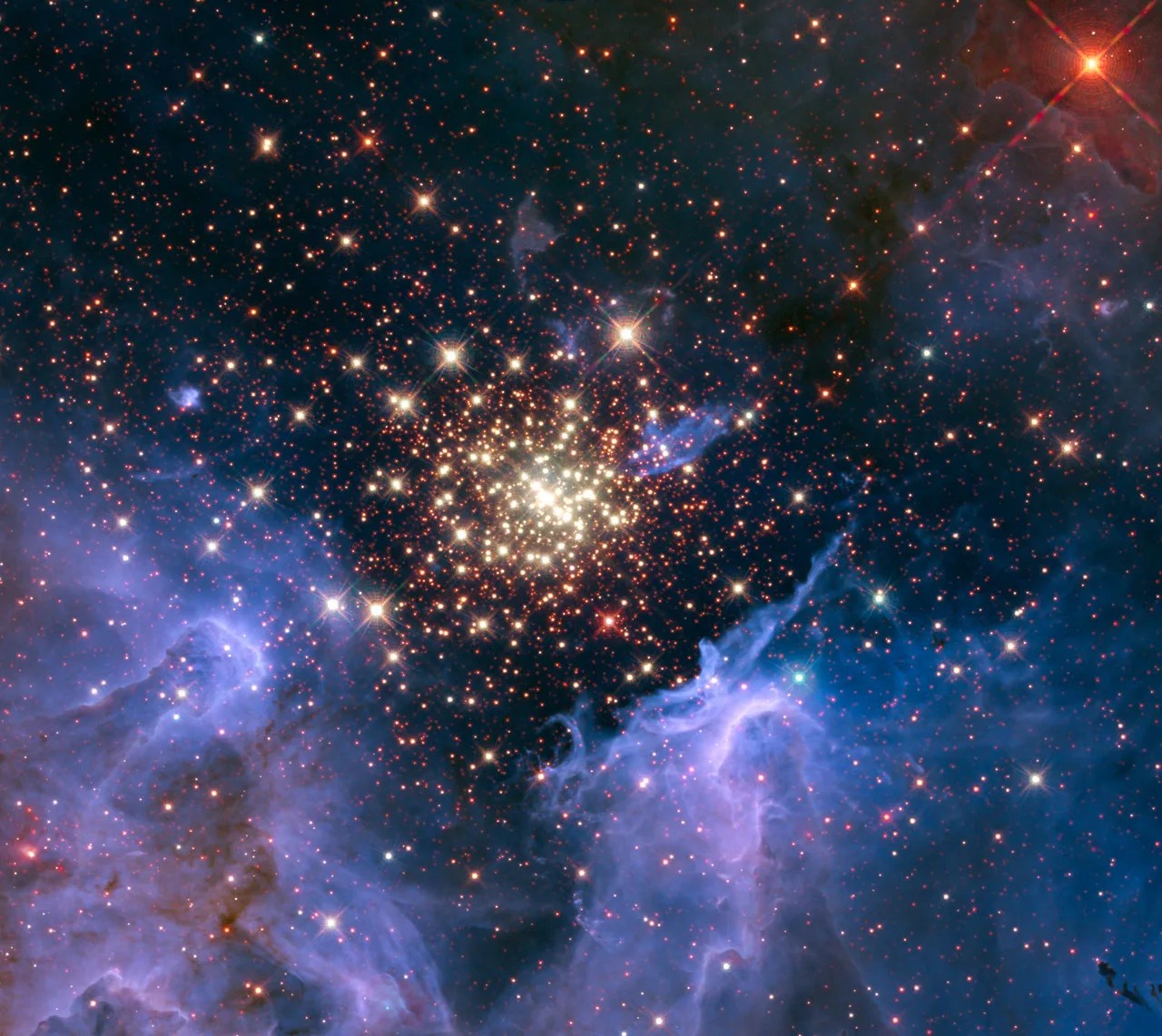
A cauldron of cosmic creation is being revealed in a new image from NASA’s James Webb Space Telescope. Webb has unveiled numerous stars formerly hidden by clouds of dust in a stellar nursery known as NGC 7129, which resides about 3,300 light-years from Earth.
Stars, the engines of elemental creation, have life cycles that begin with their birth in molecular clouds – cold, dense regions of dust and gas. Because of these dusty cocoons, young stars are often impossible to view by many telescopes, particularly those incapable of capturing infrared light. Webb, however, has a high degree of infrared sensitivity, allowing astronomers to peer through that dust and study the beginning of the star life cycle.
Image: NGC 7129 (NIRCam Image)
The stars from this cluster are in different stages of their development, as the more massive stars form and evolve the fastest. The most massive (and the most mature) is the region’s luminous central star, LkH(alpha) 234 (pronounced Lick-H-alpha). This star, which sports the image’s most prominent diffraction pattern, is a pre-main-sequence star weighing around 5 to 8 times the mass of our Sun. Pre-main-sequence stars like these have mostly finished gathering mass and are contracting under the force of gravity, causing their temperatures to rise. In time, this star will fuse its own hydrogen like our Sun.
The cavity to its left, which appears in gold and spans about 3.5 light-years, is the largest demonstration of the central star’s impact. Outflows from an earlier stage of the star’s life cycle carve into the dense molecular cloud of hydrogen. Both the outflows and the star’s light energize the gas, causing it to glow. While much of this hydrogen gas is blown away, a large amount is also compressed, creating the conditions for even more stars to form.
Interactive: The Colorful Clouds of NGC 7129
A few of these stars are visible within the cavity. Several of them are also pre-main-sequence and emit stellar winds. The nearby bow shocks, the curved compressed gas that appears near the stars, are created as those winds push into the energetic gas and create their own, smaller cavities.
Together, the central and embedded stars also create the sharp ridge seen at the top of the golden cavity. Their light generates a hot environment that pushes against the colder and denser molecular gas outside the cavity, and creates a boundary known as a photodissociation region. In this region, the molecules of hydrogen break down into atoms. By influencing the temperature and chemistry of the region, this collection of stars offers insight into how these molecular clouds will gradually erode over millions of years.
The region to the right of the central star narrates a different, but equally chaotic tale. This clumpy matter represented in red hides much younger objects than those on the left: protostars. The protostar stage is earlier than the pre-main-sequence stage and occurs after molecular clouds of gas and dust initially compress and fragment.
As the protostars accumulate matter and increase their mass, they eject outflows of superheated material. These outflows interact with the dense, gray, translucent matter the protostars are wrapped within, creating shocks that cause a textured appearance. The red glow is also the result of the interaction. Multiple outflows from multiple stars overlap from our point of view, leading to the scene’s chaotic look.
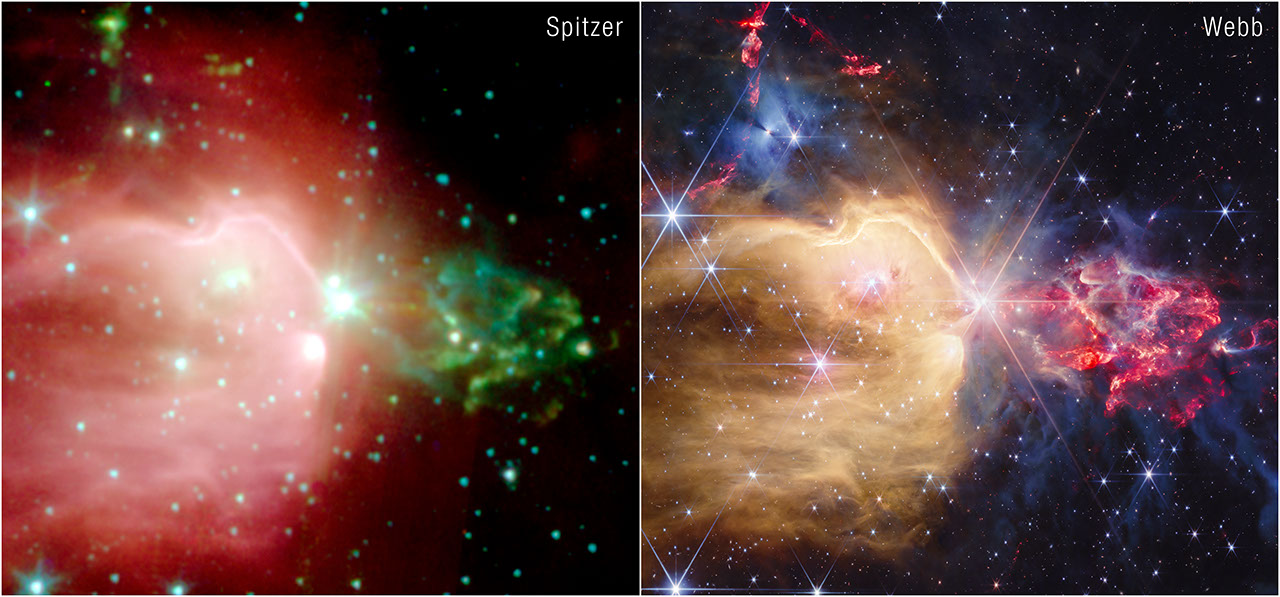
Image: NGC 7129 Side-by-Side (Spitzer and Webb Image)
More of these protostellar outflows can be seen at the upper left of the image, near a blue-colored nebula. The center of this blue region hosts a protostar surrounded by a donut-shaped disk of material. This disk casts a shadow against the surrounding nebula, reminiscent of a similar structure known as the “Bat Shadow” that was observed by NASA’s Hubble Space Telescope.
Webb’s high spatial resolution reveals many rich structures in the region’s gas, building on research done previously by NASA’s retired Spitzer Space Telescope. Astronomers will continue to use this Webb data to study how the stars and protostars in this region influence the surrounding gas and dust.
The James Webb Space Telescope is the world’s premier space science observatory. Webb is solving mysteries in our solar system, looking beyond to distant worlds around other stars, and probing the mysterious structures and origins of our universe and our place in it. Webb is an international program led by NASA with its partners, ESA (European Space Agency) and CSA (Canadian Space Agency).
To learn more about Webb, visit:
Downloads & Related Information
The following sections contain links to download this article’s images and videos in all available resolutions followed by related information links, media contacts, and if available, research paper and Spanish translation links.
Related Images & Videos
Related Links
Read more: Webb’s Star Formation Discoveries
Explore more: Image Tour: Herbig-Haro 46/47
Watch: Herbig-Haro 49/50 Stellar Jets Visualization
Explore more: Star formation in the Eagle Nebula
Watch: Celestial Lightsabers: Stellar Jets in HH24
More Webb: News | Images | Science | Home Page
Share
Details
Laura Betz
NASA’s Goddard Space Flight Center
Greenbelt, Maryland
[email protected]
Matthew Brown
Space Telescope Science Institute
Baltimore, Maryland
Hannah Braun
Space Telescope Science Institute
Baltimore, Maryland
Related Terms

Source: science.nasa.gov